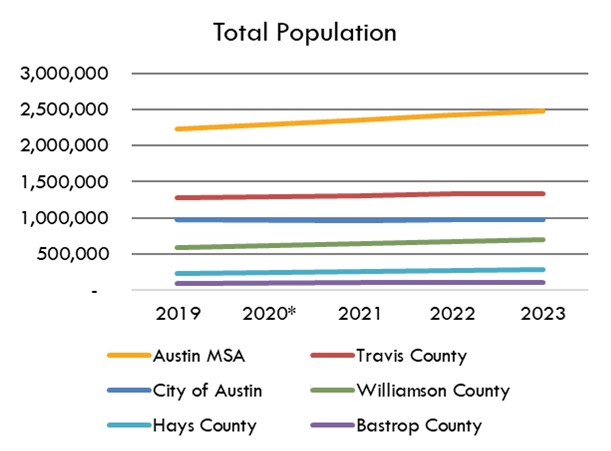
The five-county Austin MSA exceeded 2,450,000 in total population in 2023, having grown by almost 250,000 from 2019 to 2023. Today, Travis County makes up more than half of that total with a resident population of over 1.3 million people.
Hays and Bastrop Counties have grown at the fastest rates. Williamson County gained the most population, adding over 106,000 new residents (an increase of 19%) since 2019. Hays County continued to show strong growth with a rate of 23% since 2019, and reached a total population of over 280,000 in 2023. Bastrop County had the highest growth rate, having increased its population by 25% since 2019 to 110,778.
The U.S. Census Bureau reports that 47% of Travis County residents are White, 32% are Hispanic, 8% are Black and 8% are Asian. Forty-three percent of the child population are Hispanic, while 65% of the population age 65 or older is White.
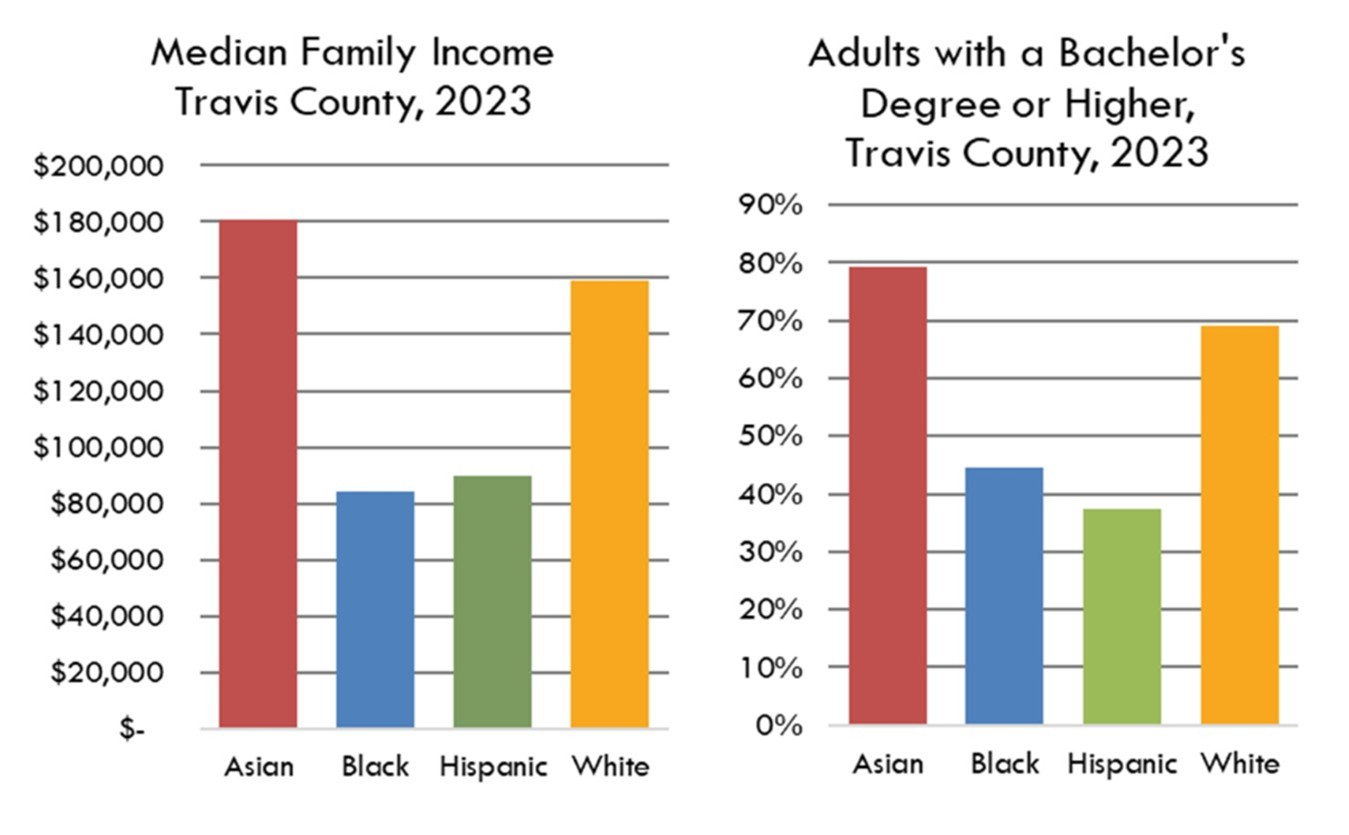
There are stark differences in educational attainment levels and median household income by race and ethnicity. The first graph depicts median family income. The second graph depicts the percent of people in Travis County, over the age of 25, who have a Bachelor’s degree or higher. Approximately 45% of Black adults over the age of 25, and 37% of Hispanic adults over the age of 25, have a Bachelor’s degree. This contributes to lower household incomes for these groups. Increasing educational opportunity and educational success for people of all races and ethnicities is one way we can bridge the economic divide and increase access to opportunity.
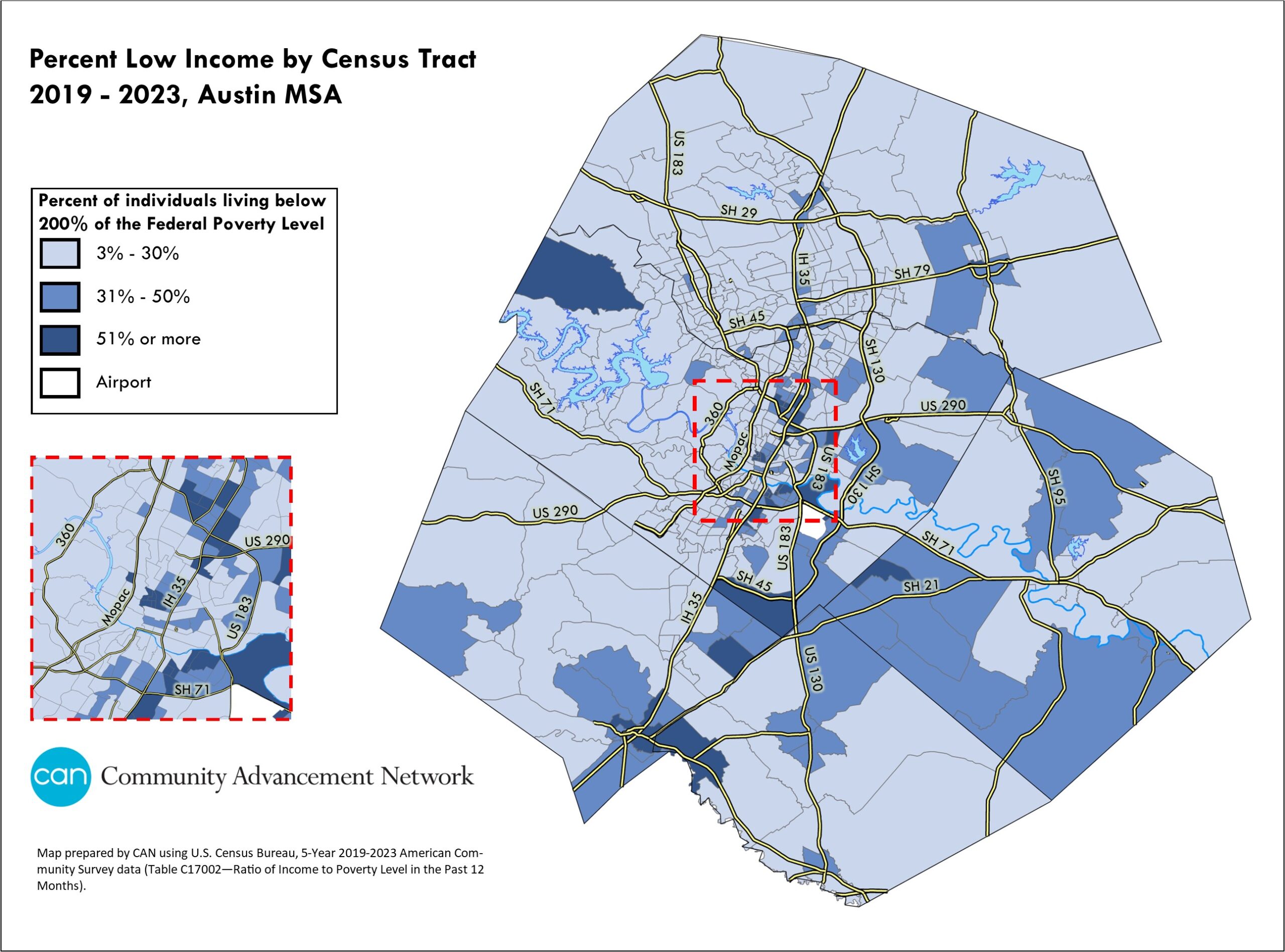
This map shows the percentage of the population within each census tract who are low-income, or earn less than two-times the federal poverty threshold or less. The Center for Public Policy Priorities estimates that it takes at least two times the federal poverty level for families to meet their basic needs.
An estimated 21% of all people living in the five-county Austin Metropolitan Statistical Area are low-income. “Low-income” is defined as people who live in a household with total earnings of less than 200% of the federal poverty threshold or less. In 2023, these were $61,800 for a family of four (consisting of 2 adults/2 children) and $49,098 for a family of three (consisting of 1 adult/2 children).
From 2014 to 2023, the Austin Metropolitan Statistical Area grew by more than 525,000 people, surpassing 2 million people in 2015. This represents a 10-year growth of 27%. The number of low-income residents declined by more than 82,000, a reduction of approximately 14%, over the same time period.
CHANGE IN LOW- INCOME
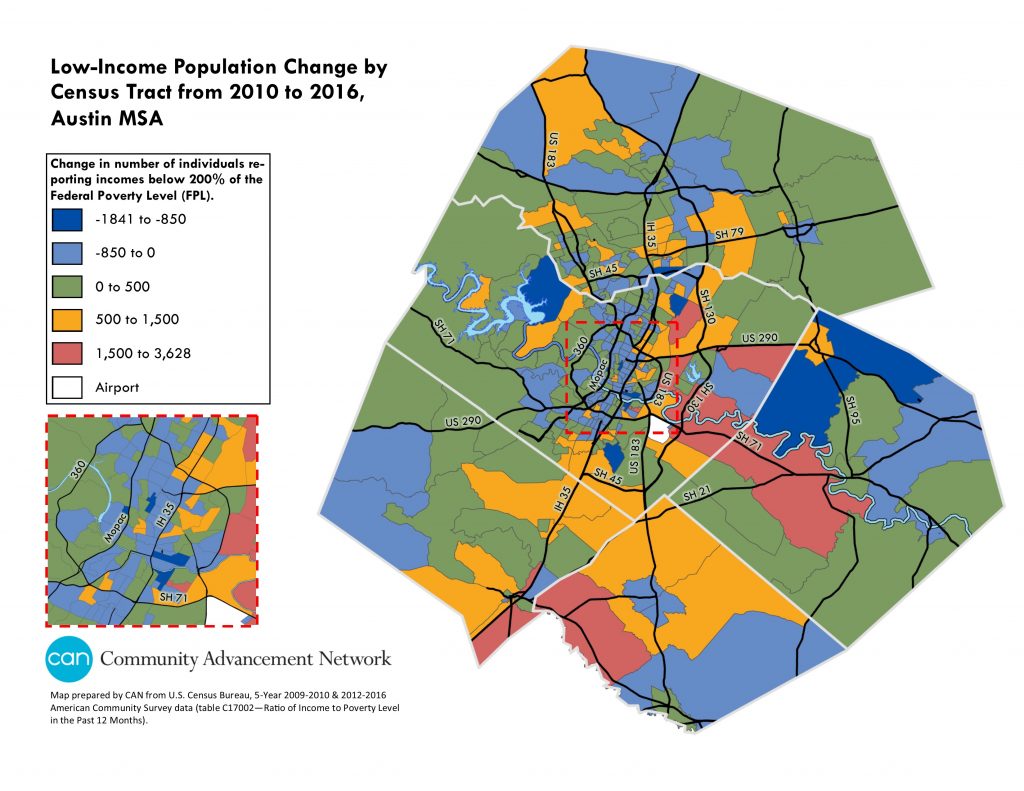
This map depicts the change in the number of low-income people reported for each census tract from 2010 to 2016.
Census tracts that are blue saw a decline in the number of people who are low-income and areas that are green saw an increase of up to 500 people who are low-income over this six year period.
Census tracts that are gold saw between 500 and 1500 additional low-income people, and census tracts that are red saw increases between 1,500 to more than 3,000 additional low-income people.
Census tracts with small low-income populations may be unreliable.
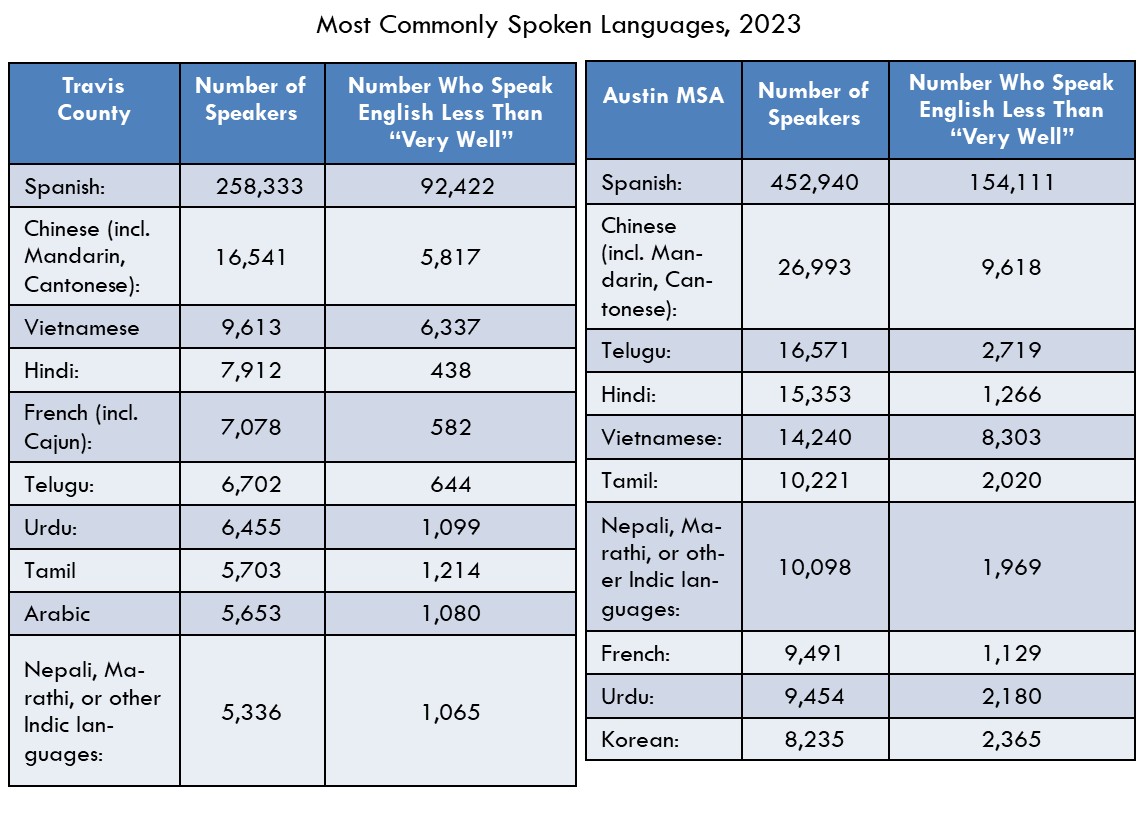
The number of Travis County residents, aged five and older, who speak a language other than English grew by 70% from 2000 to 2023, and the number of residents who speak English less than “very well” has grown by 26%. In 2023, 29% of Travis County residents age five or older spoke a language other than English, and 9% spoke English less than “very well”.
Spanish was the most commonly-spoken non-English language in Travis County and the five-county Austin MSA according to 2023 American Community Survey estimates. An estimated 36% of the Spanish speakers in Travis County speak English “less than very well,” which indicates a need for English language and adult literacy classes as well as translation and interpretation services. Chinese and Vietnamese are the next most commonly spoken languages in Travis County. More than half (66%) of Vietnamese speakers surveyed in Travis County were found to speak English “less than very well”, while 35% of Chinese speakers surveyed were found to speak English “less than very well”.